pressed
Framed Pressed Flowers
Reston VA
Your Bouquet
Reimagined
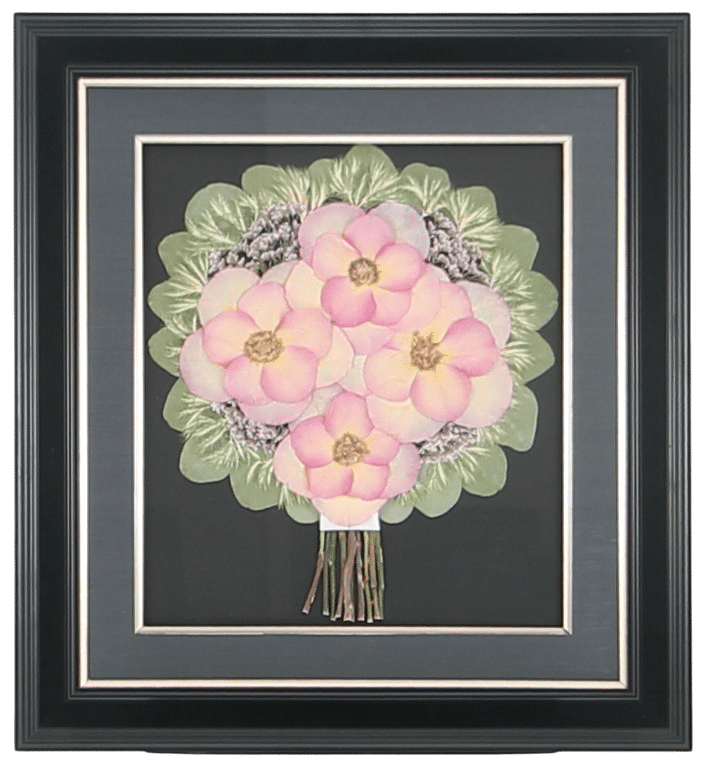
You’ve had pressed flowers in mind from the very start. The garden rose that reminded you of your grandmother’s yard. The ranunculus your florist talked you into and you’ve never been more grateful. The spray of eucalyptus that tied the whole thing together. A pressed flower piece doesn’t return your bouquet as a whole the way a shadowbox does: every flower reproduced, exactly as carried. It reimagines it instead, built from the blooms that work best for the design, each one pressed and arranged by hand into something that belongs on a gallery wall.
Each bloom is pressed using traditional wooden flower presses, the paper changed by hand: daily in the first weeks, then weekly, over the course of several months. It’s slow, repetitive work, done one flower at a time. There is no shortcut that gets a bloom from fresh-cut to archival without that time passing.
Queen & I is a studio-based preservation practice in Reston, VA: wedding bouquets exclusively, handled personally by Daniel Marcey from pickup through delivery.
What comes out of that process isn’t a copy of your bouquet. It’s a new piece, built once, from flowers that only existed in that form for one day.
What Framed
Pressed Flowers Are
Pressed flower preservation is exactly what it sounds like, and nothing like what most people picture when they hear it.
Select blooms from your bouquet are carefully arranged and placed under even pressure, which slowly draws out moisture without damaging delicate petals. The absorbent paper is changed regularly in the early stages: a critical step that wicks away moisture, prevents mold, and ensures each flower dries evenly. As the blooms cure in a controlled, low-humidity environment, they gradually transform into lightweight preserved botanicals: their intricate details intact, their color softened into something that reads less like a photograph and more like a painting.
Pressing is the preservation: the traditional wood presses are what pull the moisture out of the flower and lock its color, form, and detail in place. The museum-grade display that follows is the conservation: the archival materials and UV-protective glazing that keep what the pressing achieved from fading or breaking down once it leaves the press. Both parts matter. A beautifully pressed flower in a poorly built display will still fade and deteriorate; conservation only works if the preservation underneath it was done right.
The result is flat, botanical, and completely one of a kind. No two bouquets press the same way. The color, the petal texture, the way a ranunculus fans out differently than a peony: all of it comes through in the finished piece in a way that feels less like preservation and more like portraiture.

Explore other wedding bouquet preservation formats in detail on the wedding service page: Shadowboxes, Resin, and Bas-Relief.
A Higher Standard,
Built by Hand
Most pressed flower preservation still comes out of the same two kit suppliers that have long served this industry: pre-made mats and moulding profiles in a handful of standard sizes, meant to be ordered and then fit around whatever bouquet a preservationist is working with. Custom Framing Designs, one of those two, closed in recent years. InLine Ovals remains. The approach hasn’t changed for most of the industry: pick the closest standard size, set the pressed flowers inside, move on. It’s fast. It’s inexpensive. It’s also exactly where most preservationists stop.
At Queen & I, nothing about a pressed flower piece is bought off the shelf. Every element is custom-built in Daniel’s Reston studio around the specific composition designed for your bouquet.
The moulding is assembled by hand to construct the frame. The mat board is precision-cut using a Wizard International Computerized Mat Cutter, the industry standard in professional framing, for exacting interior dimensions matched to the composition, not the other way around. Unlike shadowboxes, which need separate stackers to build up the depth required for dimensional flowers, a pressed flower piece only needs the moulding’s own rabbet depth, since the dried botanicals lie flat.
The difference in approach is the same one that defines every piece Daniel builds: most preservationists fit the composition to a standard frame. At Queen & I, the frame is built around the composition.
Two Display Styles –
Replication and Bird’s Eye View
A pressed flower piece at Queen & I is built in one of two styles, and like everything else, that decision is made together with Daniel at the design consultation.
Both styles return your actual flowers inside the finished piece. The difference is in how you want your bouquet to be seen, and what you want the piece to say when someone notices it on the wall.
There’s no wrong choice between the two. Replication tends to resonate with brides who want the bouquet itself remembered as a shape and a moment. Bird’s Eye View tends to resonate with brides who want their flowers treated as individual subjects worth studying up close. Daniel keeps a range of finished samples in the studio so you can see both styles in person at the design consultation, helping you choose based on how each composition actually looks, not just a picture online.
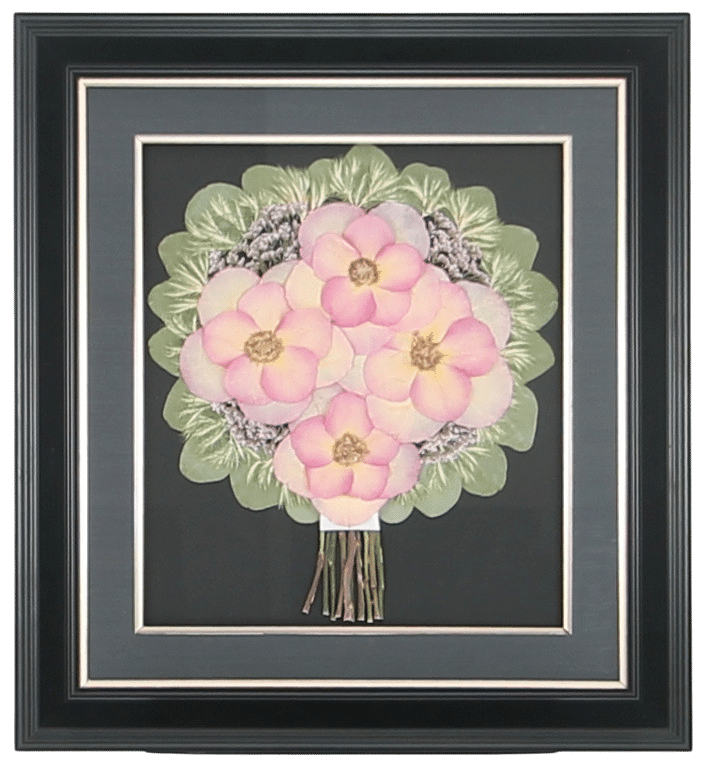
Replication
Replication takes the form of your bouquet: flowers and stems reimagined in the same arrangement you carried down the aisle. It is not an exact three-dimensional reproduction the way a shadowbox is. It is a flat, artistic interpretation of that form, hand-composed from your actual blooms. The bouquet is immediately recognizable. The medium gives it something new.

Bird’s Eye View
Bird’s Eye View presents your flowers as seen from above: the bloom design face-forward, stems removed, composed as a flat botanical study. Where the shadowbox Bird’s Eye View is your bouquet seen directly from above, the pressed version is a reinterpretation of that perspective: each flower placed with intention, the composition designed around the character of your specific blooms.
Built to Museum
Conservation Standards
A pressed flower piece is only as permanent as the materials used to frame it. Non-archival backing yellows over time, acid migrates into the petals, and glass without UV protection accelerates fading. The framing isn’t a finishing step: it’s the conservation standard that protects everything the pressing achieved.
Every piece Daniel frames in the studio uses materials trusted by the world’s leading conservation institutions: the same archival standards the Library of Congress recommends.
Larson-Juhl moulding: respected by professional framers and conservators since 1893, chosen for construction quality and long-term structural integrity.
Bainbridge matting: Artcare technology, developed specifically to protect works on paper and organic materials from the acids and pollutants that cause deterioration over time.
Tru Vue glazing: UV-protective glass that blocks the wavelengths most responsible for color loss, without distorting the clarity of what’s behind it.
Your flowers will always keep their shape. Some blooms may soften slightly in color over the years. That’s the nature of organic material. Archival framing ensures nothing in the frame accelerates that process.
Why We Never Use Glass-on-Glass Framing
A popular trend in pressed flower display sandwiches dried botanicals directly between two panes of glass, nothing else in between. It photographs cleanly, but it is not a museum-conservation approach, and it is not something Daniel will build. The risks are real, and most of them do not show up on day one. They show up months or years later.
- Trapped moisture and mold. Even flowers that seem fully dry can hold a trace of moisture. Sealed directly against glass with nowhere for that moisture to go, mold, rot, or a mushy texture can follow.
- Petals bonding to the glass. Natural plant oils and residual sap can glue delicate petals straight to the interior of the glass. Opening or adjusting the frame later tears the flower apart.
- Faster fading from sunlight. Glass alone offers no UV protection and no paper buffer. Sunlight passes straight through both panes, and color bleaches out far faster than it does behind archival, UV-protective glazing.
- Condensation damage. Ordinary temperature swings in a room create condensation on the inside of sealed glass, rehydrating dried petals and collapsing the crisp structure that took months to achieve.
- No airflow. Real preservation depends on breathable materials, like acid-free paper and cardstock, that let a piece breathe. Two solid panes of glass seal flowers into a closed environment with no airflow at all, which accelerates decay rather than preventing it.
Every material decision at Queen & I exists to avoid exactly these failure points. Archival backing, acid-free matting, and UV-protective glazing all work together so your flowers are supported and protected, not sealed into glass with no way to breathe.
Why a Pressed Flower Piece Takes Months to Complete
The traditional wood-press method that are used is slow by design, and that is the point. Across the industry, traditional pressed flower preservation runs 6 to 7 months on average from the day your flowers arrive to the day it’s finished, and that timeline comes from the physical process itself, not from a backlog.
- Moisture leaves cell by cell. Fresh petals are full of water held inside living plant cells. Instead of forcing that water out with heat, the way a dehydrator or microwave would, a wood press gently squeezes each flower and lets moisture escape gradually, one layer at a time.
- Controlled, gradual drying protects the shape. Wooden boards, cardboard, and absorbent paper slowly wick moisture away. Pull it out too fast and petals wrinkle, shrivel, or crack. Slow drying is what keeps a flower’s natural shape intact.
- Gentle drying protects color. Fast, high-heat methods tend to strip or scorch a flower’s natural pigment, leaving it brown or washed out. A slow press lets those color changes happen gradually, which is why the finished piece keeps more of its original vibrancy.
- Thicker flowers simply need more time. Roses, dense flower centers, and thick stems hold humidity deep inside multiple layers of plant tissue, and can take three to four weeks or more to fully dry, before framing even begins.
- Humidity in the room matters. Ambient humidity slows evaporation, which is why the absorbent paper around each flower is changed regularly rather than left to dry on its own timeline.
None of these steps can be rushed without damaging the piece. The months this process takes are what make the difference between a flower that holds its color and shape for decades, and one that was dried too fast to last.
“A pressed flower piece isn’t trying to be your bouquet exactly as it was. It’s something more modern than that: your flowers, reimagined into art.”
– DANIEL MARCEY, QUEEN & I
Pressed Flower
Preservation Pricing
$1250
Pressed flower preservation at Queen & I is one price, regardless of bouquet size. No additional fees for materials or options. To keep the same scale as the bouquet you carried down the aisle, Bird’s Eye View pieces run about 18 x 18 inches on average, Replication pieces closer to 18 x 20.
The same price covers pressing, your private design consultation, hand-arrangement, and archival framing, completed entirely in the Reston studio using museum-grade archival materials. Sales tax not included.
FAQ About
Framed Pressed Flowers
Reserve Your Pressed
Flower Commission
Wedding
Coming Up?
Pressed flower commissions run on the same limited schedule as every other format Daniel builds: just 2–3 spots for DC metro brides each week, so booking at least three months ahead gives you the best shot at securing your date. A call is the fastest way to start: Daniel will walk you through pricing, how your flowers are collected, and what to expect from the pressing and framing timeline, which takes longer than other formats. If you’d like to see a finished piece first, studio visits in Reston, VA are available by appointment.
Wedding
Already Passed?
A pressed flower piece can still be possible even after the wedding, but freshness matters more here than with any other format, since pressing works best on flowers that haven’t already begun to wilt. Please text Daniel a couple current photos of your bouquet first, so he can assess their real condition honestly rather than guess based on timing alone. From there, a quick call will tell you exactly what’s realistic for your flowers, and how quickly you’ll need to get them into the studio once you talk, so the pressing process can begin.
Compare Formats by Text
Get pricing and details for all four wedding service formats sent straight to your phone.

Daniel Marcey
Owner, Queen & I - Floral Preservation │ Reston, VA
Framing a pressed flower piece correctly takes two kinds of knowledge most preservationists don’t have: a deep understanding of the flower itself, and a professional framer’s eye for conservation materials and composition. Daniel brings both: two and half decades of flower preservation, paired with hands-on experience as a professional framer, applied to every piece he builds in his Reston, VA studio using the same archival materials trusted by museums and conservation institutions worldwide.